Monday, February 6, 2023

Journal Times editorial: The stadium extortion game goes on (4-6-22)

The Journal Times Editorial Board

A popular rhetorical question on social media:

What’s considered classy if you’re rich and trashy if you’re poor?

Getting money from the government.

Terry and Kim Pegula, owners of the NFL’s Buffalo Bills, have a net worth of $5.8 billion, according to Forbes magazine. Despite this, the State of New York is contributing $600 million, and Erie County is contributing $200 million, to build a new stadium for the Bills, it was announced on March 28; a headline in a news release from Gov. Kathy Hochul said the deal would “ensure” that the Bills “remain in New York State.” It’s the largest-ever contribution of public money toward an NFL stadium, surpassing the $750 million in public funds used to build Allegiant Stadium, an act that was successful in luring the NFL’s Raiders to Las Vegas from Oakland.

Or, as former Green Bay Packers executive Andrew Brandt put it on Twitter: “Socialize cost, privatize profit. Incredible business.”

We’re not blind to the reality that inducements to lure a business to a state or a municipality — tax incentives, infrastructure pledges — happen all the time.

But where are those who would condemn government handouts when it comes to professional sports teams, owned by billionaires?

Just in the NFL: The Colts left Baltimore, literally in the middle of the night, in 1984 for a publicly funded, domed stadium in Indianapolis. Stung by the loss, Baltimore committed to public funding for a new football stadium and lured the Browns from Cleveland in 1996. Stung by that loss, Cleveland committed to public funding for a new football stadium and the Browns “returned” — a new team was created, but the NFL declared that the Browns’ colors and records stayed in Cleveland — in 1999.

Throw in the Cardinals abandoning St. Louis in 1988 for Phoenix and an eventual new stadium, the Rams moving from Los Angeles to St. Louis in 1995 for a new, domed stadium, then the Rams abandoning St. Louis in 2016 for Los Angeles and a new, domed stadium. All but the Rams' return to L.A. paid for, in whole or in part, with taxpayer dollars.

In 2012, we urged the City of Milwaukee and State of Wisconsin to resist the request for public funding for a new Milwaukee Bucks arena. Fiserv Forum opened in 2018 with public funding, anyway. That funding was secured after a public threat from Bucks President Peter Feigin in July 2015 that, if a commitment to a new arena were not put in writing, the NBA would buy back the team and sell it to interests in Las Vegas or Seattle.

We were thrilled last July when the Bucks won their first NBA championship in 50 years. We’d rather the celebration on the Fiserv Forum floor that night hadn’t been set in motion by a threat to abandon the city.

Maybe, someday, a city and state will do as we initially urged when a sports team owner demands a new stadium: Tell the owner to feel free to build it themselves.

Until a government body is willing to stand up and say no, the socializing of the cost while privatizing the profit will continue.

Editorial link: https://journaltimes.com/opinion/editorial/journal-times-editorial-the-stadium-extortion-game-goes-on/article_c573dc74-b469-11ec-a530-6b7fd11b310a.html

Journal Times editorial: Disabled people's right to vote must not be restricted (3-30-22)

The Journal Times Editorial Board

Timothy Carey has Duchenne muscular dystrophy, leaving him unable to move his body. He needs the assistance of a private nurse within his home, so leaving his home is extremely challenging, the Milwaukee Journal Sentinel reported.

He still has the right to vote. The 15th, 19th, 24th and 26th amendments to the Constitution all establish that the right of everyone 18 years of age and older “shall not be denied or abridged.”

A recent ruling by a Waukesha County judge threatens Carey’s ability to exercise that right.

In a 4-3 ruling in February, the Wisconsin Supreme Court let stand Waukesha County Circuit Court Judge Michael Bohren’s decision that says voters cannot give their absentee ballots to another person to mail or to hand over to an election clerk.

Carey, who lives in Grand Chute near Appleton, would need to bring a portable ventilator and, in his words, a “boatload of gear” to get to the polls. Voting in person would increase the possibility of his catching COVID, which because of his disability could kill him. “It will basically make it impossible for me to vote,” he said.

People should not have to risk their lives to vote.

We have come a long way from the fearful situation we were in two years ago this week. Vaccination against COVID-19 has been available to nearly every adult for almost a year, so we believe there are far fewer people who can — or, at least, who should — be able to claim “indefinite confinement” than there were during the 2020 elections.

But people with substantial physical disabilities should be able to claim it.

The lawsuit over returning ballots was brought in 2021 by two men represented by the conservative Wisconsin Institute for Law & Liberty. “The rule under state law says ‘by the elector,’ so the elector has to be the one to mail their ballot or deliver it to the clerk,” said their attorney, Luke Berg. “They can’t hand it off to somebody else to do it for them.”

Berg noted there are programs to help disabled and elderly people vote, the Journal Sentinel reported. Poll workers typically visit nursing homes to assist residents to vote; those would be the Special Voting Deputies that have been in the news recently.

Clerks allow curbside voting for people who can’t get easily get out of a car. In some cases, letter carriers will pick up and deliver mail to the front door instead of a mailbox at the end of a driveway if the recipient has a medical condition.

The state high court is expected to decide by this summer what the rules will be for the Aug. 9 primary and Nov. 8 general election, when residents of the Badger State will vote for governor, U.S. senator and other offices.

In that decision, the state Supreme Court must make clear that accommodations are required for people like Timothy Carey. The Constitution says his right to vote shall not be denied or abridged.

Editorial link: https://journaltimes.com/opinion/editorial/journal-times-editorial-disabled-peoples-right-to-vote-must-not-be-restricted/article_eefb33be-aee5-11ec-a36c-c39d6368f074.html

Journal Times editorial: Simone Biles, 'the twisties' and mental health (8-9-21)

The Journal Times Editorial Board

Gymnasts call it “the twisties.” It’s like “the yips” in golf, only with far more serious consequences.

It’s what Simone Biles was experiencing when she withdrew from the all-around competition at the Tokyo Olympics.

Biles posted a video of herself during practice on the uneven bars on July 30 in which she tries a 1½ twist and falls flat on her back, ESPN.com reported.

“I don’t think you realize how dangerous this is on hard/competitive surface,” she commented along with the video.

Biles had a bad performance on the vault in the women’s team final on July 27. She had the appearance of being lost in midair — that’s “the twisties” — which can cause serious injuries to gymnasts who perform airborne routines. It usually takes some time before the gymnasts can get over the twisties.

This was not happening before she left the U.S, Biles said, adding that “it randomly started happening after prelims competition the very next morning.”

Answering questions from fans, Biles said she was still dealing with the twisties as of July 30, adding, “Sometimes I can’t even fathom twisting. I seriously cannot comprehend how to twist. Strangest and weirdest thing as well as feeling.”

Biles, as you may know, is on the short list for greatest gymnast in the history of the sport. There are gymnastic moves named for her: “The Biles” is a double-twisting, double somersault off a balance beam. “The Biles II” is a triple-twisting, double somersault in her floor routine.

So when this particular young woman says she “seriously cannot comprehend how to twist,” that’s a disconnect between mind and body, in a sport where such a disconnect can lead to serious injury.

If a golfer doesn’t feel mentally ready to compete but competes anyway, the worst that could happen is that he gets a bad score.

If a gymnast of Biles’ caliber doesn’t feel mentally ready to execute complex midair maneuvers, she could break her neck and die.

In other words, the stakes are a bit higher.

So when the couch potatoes got in Keyboard Warrior mode and took to social media — and in some cases, traditional media — to chastise Biles for prioritizing her mental health over Olympic glory, they revealed their ignorance.

Simone Biles didn’t cross the Pacific with her U.S. Olympic teammates to not compete. But at a crucial moment, she wasn’t mentally healthy.

She absolutely made the right decision to not compete until she was mentally ready. She returned to competition last week, taking bronze on the balance beam with a series of flips and somersaults, but no twists.

“I wasn’t expecting to medal,” she said after Tuesday’s competition. “To have one more opportunity to be at the Olympics meant the world to me.”

Simone Biles doesn’t owe you anything.

She owed it to herself to prioritize her mental health, to recognize that it’s no less important than physical health.

Editorial link: https://journaltimes.com/opinion/editorial/journal-times-editorial-simone-biles-the-twisties-and-mental-health/article_28dc932e-afe3-5e28-807c-306b4d6e7b55.html

Journal Times editorial: Finally, a U.S. president acknowledges the Armenian genocide (5-5-21)

The Journal Times Editorial Board

This newspaper told Vartenie Dadian’s story in 2000. She was 94 at the time. Rob Golub, later managing editor of The Journal Times, told her story.

When she was a preteen, Mrs. Dadian said, soldiers took the Armenian men away from the village of Tomarza, Turkey, including Mrs. Dadian’s father. She never saw him again.

Perhaps days or weeks later, she said, “somebody came in the morning and said ‘This house has to be empty in an hour or two.’ “ Her mother gathered up bread, and they joined the walk.

“Turks, they take everything and they let us walk,” Dadian said. “We left everything ... I lost my family. I lost my mother.” Dadian’s mother died on the walk, after mother and daughter somehow became separated. The Armenian refugees walked from Turkey to the Syrian desert. Dadian was placed in a British orphanage. She was brought to the United States by the man who became her husband.

In Golub’s telling of Dadian’s story, he quoted her eldest daughter, Akgulian, regarding being awed by her mother’s story. Akgulian said: “I think all of us feel very special, that we are existing because of her.”

Golub’s report was published on April 24, 2000; that night, people of Armenian ancestry around the world held their annual remembrance of the Armenian genocide, when 1.5 million Armenians were systematically killed by the soldiers and government of the Turkish Ottoman Empire.

Five years and four days after we told Vartenie Dadian’s story, we published a letter to the editor from Zohrab Khaligian, a Racinian and a member of the Armenian National Committee of Wisconsin.

“It was deeply insulting to read the article ‘Some Turks confront World War I massacre of Armenians’ on April 17th because it continues The Journal Times’ policy of publishing articles that deny the Armenian genocide,” he wrote, adding that in a 2004 Associated Press report we published, “the Armenian genocide is referred to as an Armenian allegation with statements like ‘Armenians say.’ “

Citing a bill adopted by both houses of the Wisconsin Legislature and a proclamation by then-Gov. James Doyle in 2005 that designated April 24 as “Wisconsin Day of Remembrance for the Armenian Genocide of 1915 to 1923,” he wrote: “Isn’t it enough … for The Journal Times to also characterize the Armenian genocide as genocide?”

Mr. Khaligian was right, and we knew it. So we published his letter with an editor’s note: “It is not Journal Times policy to deny historical fact, as the Armenian genocide clearly is. Stories in The Journal Times will reflect this policy.”

From that point forward, whenever The Journal Times published an Associated Press report regarding the matter, we inserted the following sentence: “The Journal Times recognizes the Armenian genocide as historical fact.” Why did we do this?

For our neighbors.

Racine doesn’t make the City-Data.com list of the 101 U.S. cities with the largest number of people born in Armenia. But all the proof you need of the sizable Armenian-American community in Racine is the presence of two Armenian Apostolic churches — St. Hagop, 4100 Newman Road, and St. Mesrob, 4605 Erie St.

In a city where so many survivors of the genocide had settled and raised families, we could no longer refuse to stand with our Armenian-American neighbors.

“Too many people get the wrong idea, why we remember,” the Rev. Yeprem Kelegian of St. Mesrob, himself the son of survivors of the genocide, said in 2000. Forgetting he said, “becomes mental and moral sloth.” Kelegian said a tendency toward hate and genocide always exists, and without memory, “you allow those tendencies to creep back in.”

But four presidents, two Republicans and two Democrats, failed to acknowledge historical reality in the 21 years after we told Mrs. Dadian’s story. Finally, on April 24, President Joe Biden acknowledged it.

“The American people honor all those Armenians who perished in the genocide that began 106 years ago today,” Biden said in a statement. “We affirm the history. We do this not to cast blame but to ensure that what happened is never repeated.”

We’re thankful that President Biden took a stand and formally recognized the Armenian genocide.

We wish, for the sake of our neighbors, that it hadn’t taken from Woodrow Wilson onward for an American head of state to do so.

Editorial URL: https://journaltimes.com/opinion/editorial/journal-times-editorial-finally-a-u-s-president-acknowledges-the-armenian-genocide/article_6db52d1d-39e7-5df8-a1d4-3795569df3e2.html

Packers hope to add to rich playoff history (Journal Times, 1-3-97)

BY TOM FARLEY

Journal Times

Although they haven’t won the NFL championship since 1967, the Green Bay Packers still have won more league titles than any other team. With 11 titles, the Packers have two more than the Chicago Bears and five more than the New York Giants, the team with the third most.

What follows is a look at the Packers postseason history (Green Bay won NFL championships in 1929, '30 and '31, years in which the team in first place at the end of the regular season won the championship): Dec. 13, 1936: Arnie Herber threw two touchdown passes, one for 43 yards to second-year split end Don Hutson, as the Packers beat the Boston Redskins 21-6 in the NFL Championship Game at the Polo Grounds in New York. Bob Monnett ran two yards for the Packers’ other touchdown.

Dec. 12, 1938: Ed Danowski connected with Hank Soar for a 23-yard touchdown pass and the winning score as the New York Giants beat the Packers 23-17 at the Polo Grounds for the NFL title. A leg injury to Hutson hindered the Packers’ offense.

Dec. 10, 1939: Amid wind gusts of up to 35 mph at State Fair Park, the Giants threw six passes that were intercepted as Green Bay routed New York 27-0 before 32,279, then a record crowd for a pro sporting event in Wisconsin. Herber and Cecil Isbell had three passes intercepted, but the rest of their passes were caught by Packers, including one touchdown pass each.

Dec. 14, 1941: In a playoff for the Western Division championship at Wrigley Field, the Bears scored 30 straight points to rally from a 7-0 deficit and win 33-14. The Bears focused on shutting down Hutson and did so, limiting him to one reception for 19 yards.

Dec. 17, 1944: Using Hutson as a decoy, the Packers rushed for 184 yards and beat the Giants 14-7 at the Polo Grounds for Green Bay’s sixth league title. Joe Laws rushed for 72 yards in 13 carries and intercepted three passes, a postseason record that stood for 35 years.

Dec. 26, 1960: Chuck Bednarik tackled Jim Taylor on the Philadelphia Eagles’ 9-yard line on the final play of the game, preserving a 23-17 Eagles victory for the NFL championship in the only postseason game Vince Lombardi’s Packers would lose. Taylor rushed for 105 yards in 24 carries.

Dec. 31, 1961: Paul Hornung scored 19 points on a touchdown, three field goals and four extra points as the Packers routed the Giants 37-0 at Lambeau Field in the first postseason game in Green Bay. The Packers scored 24 points in the second quarter and held the Giants to 130 total yards and six first downs. Bart Starr threw three touchdown passes, two to Ron Kramer and one to Boyd Dowler.

Dec. 30, 1962: Amid 35-mph winds at Yankee Stadium, Jim Taylor ground out 85 yards on 31 carries and scored the Packers only touchdown in a 16-7 victory over the Giants. Guard Jerry Kramer, filling in for Hornung, kicked three field goals, the last with 1 minute, 50 seconds to play to clinch a second straight NFL championship.

Dec. 26, 1965: Despite losing Starr to bruised ribs on the Packers first offensive play, the Packers beat the Baltimore Colts 13-10 in overtime in a playoff for the Western Conference championship at Lambeau Field. Hornung ran 1 yard for the Packers’ only touchdown, and Don Chandler kicked two field goals, including the game-winner in overtime.

Jan. 2, 1966: Hornung (105 yards rushing) and Taylor (96 yards) ground out a 23-12 victory over the Cleveland Browns at snowy, muddy Lambeau Field. Green Bay drove 90 yards in 11 plays, including a power sweep with Jerry Kramer leading Hornung to a 13-yard touchdown that gave the Packers a 20-12 lead with 5:42 left in the third quarter.

Jan. 1, 1967: On fourth and goal from the Packers 2-yard line with 28 seconds remaining, Dave Robinson grabbed Dallas Cowboys quarterback Don Meredith as he released a pass and Tom Brown intercepted to clinch a 34-27 victory and a second straight NFL championship. Starr passed for 304 yards and four touchdowns.

Jan. 15, 1967: The Kansas City Chiefs made the first Super Bowl interesting for 30 minutes, going into the Los Angeles Memorial Coliseum locker room at halftime down only 14-10. But Willie Wood intercepted a Len Dawson pass and returned it 50 yards to the Chiefs 5, setting up an Elijah Pitts touchdown with 2:27 elapsed in the third quarter. Pitts rushed for two touchdowns, as did Max McGee, who caught seven passes for 138 yards.

Dec. 23, 1967: The Packers avenged a regular-season loss to the Los Angeles Rams by beating them 28-7 at County Stadium for the Western Conference title. Travis Williams rushed for 88 yards, including touchdown runs of 46 and 2 yards, and Starr passed for 222 yards and a touchdown to Carroll Dale.

Dec. 31, 1967: In what’s become known as the Ice Bowl a 13-below-zero day at Lambeau Field the Packers, down 17-14, drove 68 yards in the game’s final five minutes, scoring when Kramer cleared a path for Starr’s 1-yard run.

Jan. 14, 1968: Against the Oakland Raiders in Super Bowl II in Miami’s Orange Bowl, the Packers took a 13-0 lead in the game’s first 20 minutes, got the third of Chandler’s four field goals to go up 16-7 on the final play of the first half. Donny Anderson scored on a 2-yard run and Herb Adderley’s 60-yard interception return with 11:03 left in the game put the finishing touch on a 33-14 win.

Dec. 24, 1972: In an NFC divisional playoff at RFK Stadium, the Washington Redskins used a five-man defensive line, in effect daring the run-oriented Packers to pass. The Packers could muster only a 17-yard field goal by Chester Marcol, losing 16-3 as John Brockington was held to nine yards on 13 carries.

Jan. 8, 1983: Seeded third in the NFC after a strike-shortened season, the Packers routed the St. Louis Cardinals 41-16 at Lambeau Field as Lynn Dickey passed for 260 yards and four touchdowns. John Jefferson had six receptions for 148 yards and two touchdowns while Eddie Lee Ivery scored two touchdowns.

Jan. 16, 1983: The Packers gained 466 yards against the Cowboys at Texas Stadium, but Dallas Dennis Thurman intercepted Dickey three times, once for a touchdown, as the Cowboys beat the Packers 37-26. Lofton caught five passes for 109 yards and a touchdown and took a reverse 71 yards for another touchdown.

Jan. 8, 1994: Brett Favre rolled left and threw back across the field to Sterling Sharpe for a 40-yard touchdown with 55 seconds to play to give Green Bay a 28-24 victory in a wild-card playoff game in the Silverdome. George Teague set an NFL postseason record when he returned an interception 101 yards for another touchdown.

Jan. 16, 1994: In the first of three straight postseason trips to Texas Stadium, the Packers take a 3-0 lead but see the Cowboys score 17 straight points and win 27-17. Dallas Troy Aikman passes for 302 yards and three touchdowns and Michael Irvin has nine catches for 126 yards.

Dec. 31, 1994: The Packers’ defense holds Barry Sanders to minus-1 yard on 13 attempts and sets a postseason record by holding the Lions to minus-4 yards rushing in a 16-12 victory at Lambeau Field.

Jan. 8, 1995: The Packers gain 327 yards but lose 35-9 to the Cowboys at Texas Stadium as Aikman passes for 337 yards.

Dec. 31, 1995: Edgar Bennett sets a team postseason record by rushing for 108 yards as the Packers beat the Atlanta Falcons 37-20 in a divisional playoff at Lambeau Field.

Jan. 6, 1996: Craig Newsome grabs Adam Walker’s fumble and returns it 31 yards for a touchdown, helping the Packers take a 21-0 lead en route to a 27-17 upset of the 49ers in San Francisco.

Jan. 14, 1996: The Packers take a 27-24 lead into the fourth quarter of the NFC Championship Game at Texas Stadium, but the Dallas offensive line wears down Green Bay as Emmitt Smith rushes for two touchdowns in the final 15 minutes as the Cowboys win 38-27.

Article link: https://journaltimes.com/news/local/packers-hope-to-add-to-rich-playoff-history/article_7b734281-c256-59e6-bfa9-f3388be0288a.html

Fans almost close opener (Journal Times, 4-8-97)

BY TOM FARLEY

Journal Times

MILWAUKEE -- Unruly behavior by about a hundred spectators threatened to ruin the day for more than 42,000 baseball fans at Milwaukee County Stadium Monday. It also could have cost the Brewers their first home game of the season.

Souvenir baseballs, given to each fan as they entered the ballpark, were thrown onto the field just before the start of Monday's home opener and in the first and second innings of the Brewers' game with the Texas Rangers. That prompted the Rangers to twice leave the field out of concern for player safety.

The baseball-throwing slowed when fans were warned via the scoreboard that such behavior could cause the Brewers to forfeit the game, but it did not cease until Brewers manager Phil Garner and umpire Jim McKean took to the field and used the public-address system to ask the fans not to throw the baseballs.

"We have a beautiful day," Garner said. "We want to play baseball. We urge you, for the safety of the players, the umpires and your fellow fans: do not throw any more baseballs on the field."

Garner was happy the game was allowed to resume, especially after the Brewers beat the Rangers 5-3 before a paid attendance of 42,893.

The game was delayed twice for a total of 30 minutes while the players and umpires waited for the baseball-throwing to stop.

Reaction by a majority of fans to the actions of a few was negative. After the players left the field, as the baseball-throwing continued, fans began booing and pointing out offenders to stadium security personnel and Milwaukee County Sheriff's Department officers.

"Ridiculous," said Jim Taylor of Brookfield.

"It was pretty embarrassing," said Jamie Baade of Wauwatosa. "We don't even deserve this team if they (fans) are going to act like that. The Brewers are nice enough to give people baseballs, but why should they bother if people are just going to abuse it?"

The baseballs are being given away at the first home game of 20 of the 28 teams through a promotion with a national hardware-store chain. Eight teams decided not to participate in the baseball-giveaway promotion, said Phyllis Merhige, the American League's vice president of media affairs and administration. The same type of incident occurred at several other ballparks on opening day, Merhige said.

Baade said that the people throwing baseballs weren't there for the game.

"You have to wonder, how many people (throwing baseballs) are really baseball fans, and how many come out here and just get drunk for the sake of getting drunk?" Baade said.

Among the 112 citations issued by the Milwaukee County Sheriff's Department, 14 were for throwing baseballs on the field. They will be fined $105 each.

Before the game was over, Bud Selig, the Brewers' president and acting commissioner of Major League Baseball, issued a directive to all teams that had yet to have their home opener. He instructed the teams to issue the baseballs to fans as they left the stadium, rather than before the game.

"You're talking about a few people who are spoiling it for all the people," Selig said. "It's sad. But it's happened in every other ballpark. All of us are sorry about what happened here, but all's well that ends well. Now, what we have to do is make sure it doesn't happen again."

What should have been a fun experience turned into a bad scene, Garner said.

"Certainly, there was some very poor judgment on the part of a few fans," he said. "Thank God it wasn't bat giveaway day."

The Brewers have not forfeited a game in their 28-year history. The Los Angeles Dodgers were the last team to lose by forfeit. Umpires halted the Dodgers' Aug. 10, 1995, home game, stating that fans created "sufficient danger" by littering the field with more than 200 souvenir baseballs. The Dodgers' forfeit gave the St. Louis Cardinals a 2-1 victory.

Article link: https://journaltimes.com/news/local/fans-almost-close-opener/article_271b147f-8339-58c8-8ec8-8e41f787e0a5.html

Journal Times editorial: UW schools dishonor Fredric March with shoddy research (8-25-21)

The Journal Times Editorial Board

Frankly, we expected better from institutions of higher learning such as the University of Wisconsin-Madison and UW-Oshkosh.

Fredric March was born in 1897 in Racine. He grew up in the 1600 block of College Avenue, graduated from Racine High School — there was only one public high school in the city at the time — then attended UW-Madison before going on to an illustrious acting career, winning two Oscars and two Tonys.

He also was a member of a UW-Madison campus organization called “Ku Klux Klan.”

Now if the investigation into March’s life began and ended there, we can see where the UW-Madison Memorial Union might decide that March was no longer worthy of having his name on a theater space in the building; it did just that in 2018. Had the investigation gone no further, we can see where UW-Oshkosh might decide March’s name should no longer be on its theater arts center, an honor given to its “adopted son” in 1971; Oshkosh followed suit and removed March’s name in 2020.

The Wisconsin Union Council — made up mostly of students but also some alumni, faculty and staff — made the decision to remove March’s name and it has no plans to revisit the issue, Union spokesperson Shauna Breneman said.

The problem lies in the shallowness of the examination of March’s life, the seemingly knee-jerk, case-closed reaction to March having been a member of a group with the same name as a notorious group of white supremacists.

March belonged to a UW-Madison student interfraternity society formed in 1919 that bore the “Ku Klux Klan” label, the Wisconsin State Journal reported Aug. 16.

A committee studying the history of the KKK on campus found the group appeared not to have been affiliated with any larger Klan groups nor did it find any evidence that the group engaged in acts of terrorism, violent intimidation or other activities commonly associated with the Klan.

The group also appears to have tried to distance itself from the national Klan, the report found. It changed its name from the KKK to “Tumas” after a second student group — a Klan-controlled housing fraternity, Kappa Beta Lambda, or KBL, for “Klansmen Be Loyal” — surfaced in 1924 and was tied to the national Knights of the Ku Klux Klan.

So the group with the name that suggested it was comprised of white supremacists wanted nothing to do with actual white supremacists on campus.

Then there is the matter of the 55 years between March’s 1920 graduation from UW-Madison and his death in 1975.

UW-Madison alumnus George Gonis did the kind of research on March you would expect college students and faculty to undertake before deciding to rescind the honors given to him.

Gonis, who earned degrees in journalism and history, published his research in an online film magazine last fall. The 17,000-word article argues that UW-Madison, UW-Oshkosh, the Union and media ignored March’s well-established legacy as a social justice advocate who worked alongside some of the biggest names in the civil rights movement.

“There appeared to be no sifting and winnowing,” he wrote. “There appeared to be no continual search for truth from those demanding the removal of March’s name.”

Among the findings Gonis cites in his report:

— March was among a handful of celebrities to publicly back Marian Anderson, an opera singer who in 1939 was barred from a performance in Washington, D.C., because she was African American. His name appeared on an event program as a sponsor.

— The NAACP in 1964 asked March to deliver a keynote address on live TV celebrating the 10th anniversary of the Brown v. Board of Education decision. The organization cited the actor as “one of its longtime friends” when making the request.

— March narrated a documentary about blacks serving in the military during World War II. A radio program he narrated also recognized their efforts.

— March forged friendships with a long list of progressive activists, including NAACP executive secretary Roy Wilkins, who lauded the actor’s “past and present support of our efforts.”

— March attended a secret meeting for Martin Luther King Jr. and some of his supporters in the Manhattan apartment of singer Harry Belafonte in 1963, just before King headed to Alabama where he would write his famous “Letter from Birmingham Jail.”

— When Birmingham police used fire hoses and German Shepherds to quell peaceful demonstrators in 1963, March signed a telegram scolding President John F. Kennedy for not doing more to protect the protesters.

On balance, Fredric March was a man who spent decades as an ally in the fight for civil rights for African Americans. A man whom the civil rights leaders of his time praised as a longtime friend and supporter. A man worthy of being honored both at his alma mater and at the UW school in the city that had claimed him as its own.

This is something that would have been evident, had the kind of research routinely expected of college students actually taken place before the late actor was stripped of the honors.

Editorial link: https://journaltimes.com/opinion/editorial/journal-times-editorial-uw-schools-dishonor-fredric-march-with-shoddy-research/article_2a844c7c-a565-5189-b69f-540bc29e4d0b.html

Commentary by Tom Farley on 9/11: 'You have to get down here' (Journal Times, 9-11-21)

TOM FARLEY

The (Racine, Wis.) Journal Times

Sep 11, 2021

“Tom, this is Liz,” Elizabeth Young, our features editor, said at the other end of the line. “You have to get down here.”

“What are you talking about?” I replied, not entirely awake yet.

“Oh!” she said in realization. “Turn on your TV.”

I’ve been a professional journalist since 1990. For all but 7 of those years, I’ve been an editor. Reporters frequently have to drop what they’re doing and go cover something, but editors’ work is almost always scheduled. The one exception for me was Sept. 11, 2001.

On that day, I was The Journal Times’ news editor, overseeing the editing of the daily news pages. We had made the Tuesday paper, the one dated Sept. 11, the night before.

Because I worked nights, as did Terry, and because our 5-year-old was in the second or third week of afternoon kindergarten at Jefferson Lighthouse Elementary School, everyone in our house was asleep when the phone rang just after 9 a.m.

I turned the TV on, and saw one of the images that no one who remembers that day can ever forget: Black smoke billowing from the towers of the World Trade Center, and the on-screen graphics indicating that commercial airliners had struck each of the towers.

Dick Johnston, our publisher at that time, and the late Randy Brandt, then our managing editor, had decided that we would publish an extra. It’s the only extra The Journal Times has printed in the past three-plus decades.

When I arrived Downtown, people were gathered around the newsroom’s high-mounted TV, gazing upward in shock and disbelief the way so many others were across America that morning.

There were facts that we learned in the subsequent days, months and years:

• President George W. Bush was reading to children in a Florida classroom when he received news of the attacks. Air Force One, with the president back aboard, would spend that afternoon and early evening darting around the nation to keep him safe.

• Passengers on United Flight 93 from Newark, New Jersey, scheduled to travel to San Francisco, had learned of the two planes that struck the World Trade Center towers, and of a third that had struck the west wall of the Pentagon. Their flight had also been hijacked, and they decided that they would fight back.

• Col. Marc Sasseville and Lt. Heather Penney of the District of Columbia Air National Guard had been sent to find Flight 93, and had received “shoot to kill” orders. But they had scrambled in unarmed aircraft, meaning they had been sent on a kamikaze mission.

None of those facts were known to those of us working at the corner of Fourth Street and Wisconsin Avenue that morning and early afternoon.

We looked at the bulletins being sent by the Associated Press. We watched along with our professional colleagues on the 24-hour news channels as the twin towers of the World Trade Center collapsed to the ground in Manhattan and the Pentagon burned. We gathered the news as best we could.

Ron Kuenstler, one of our staff photographers, had been dispatched to General Mitchell International Airport in Milwaukee. He captured an image of a woman, who declined to identify herself, reciting the rosary as she watched on TV with others inside the terminal. He made it back in time for him to process his film; our photographers were still shooting with film in 2001. That photograph appears on Page A3 of today’s Journal Times.

Somehow, some way, we pulled together enough information for an eight-page extra, which printed at about 1:15 that afternoon.

“America attacked” was the headline on the front page of the extra. As you can imagine, it’s the largest headline I’ve ever put on a page.

The subhead says “Terrorists strike New York, Washington, Pennsylvania.” The only thing we knew at midday that Tuesday was that a fourth plane had crashed “outside Pittsburgh,” as the AP reported; we didn’t know that Flight 93 had crashed in a field near Shanksville, Pennsylvania, because its occupants had fought back against the hijackers, that the passengers and flight crew had saved countless lives, and spared the lives of Col. Sasseville and Lt. Penney, by preventing the terrorists from reaching their target.

After proofing the extra down in the pressroom, I brought a few copies of the extra up to the second-floor conference room, where Randy Brandt had gathered the newsroom staff. There was spontaneous applause; I don’t think any of us knew what else to do in that moment.

Then we discussed what we were going to cover in the Wednesday, Sept. 12 paper.

When I picked up our 5-year-old from Jefferson Lighthouse School that afternoon, I had already decided not to say anything about what had happened in the world that day. There was still time for childhood innocence; learning about the evil in this world could wait.

Tom Farley is managing editor of The Journal Times.

Commmentary link: https://journaltimes.com/news/local/commentary-by-tom-farley-on-9-11-you-have-to-get-down-here/article_d44fb881-b813-5b61-bbc2-e9ace513728e.html

Thursday, February 4, 2016

Super Bowl II Original Broadcast: The NFL Isn't Letting You See That, Either

After NFL Productions belatedly figured out last month that people didn’t want to watch a reconstruction of Super Bowl I with an uninformed commentary track -- although it took an overwhelmingly negative response on social media to help them reach that conclusion -- an enjoyable combination of NFL Films footage and the late Jim Simpson’s original play by play for NBC radio aired on NFL Network on Jan. 22.

But, for football-history buffs who’d grown up looking forward to the Super Bowl highlights marathon every January (first on ESPN, now on NFL Network), and who had seen a lot of the NFL Films footage of the Green Bay Packers and Kansas City Chiefs before, the real prize of the Jan. 22 telecast was two pieces of videotape from the original broadcast: Ray Scott announcing the starting lineups -- complete with the individual players running toward an on-field camera, in the style of the time -- and Pat Summerall’s postgame interview with NFL Commissioner Pete Rozelle.

Those two segments were the longest pieces of the original broadcast seen on television since 1967. As was addressed on the telecast, no network master tape of the game exists. A fan’s home recording of much of the game exists, but it sits in legal limbo as the league will neither buy the home recording from the tape’s owner, Troy Haupt, nor allow it to be shown to the general public.

There’s a tape of Super Bowl II out there, too. The NFL isn’t letting you see that, either. Although it came close to letting you buy it on DVD in 2008.

On April 2, 2008, with Packers fans pondering life without Brett Favre at quarterback in the wake of his (initial) retirement announcement the previous month, the Packers issued a news release inviting fans to cast votes from a list of 20 games to determine the original broadcasts to be included on the “10 Greatest Games: Packers” DVD set. The ballot was heavy with Favre Era games, with only three of the 20 on offer having been played before Favre’s arrival in Green Bay in 1992.

But one of those three was Super Bowl II.

I was thrilled at the prospect of not only seeing footage from Vince Lombardi’s last game as Packers coach but also having my own copy on DVD. I try to not think about how much I would have been willing to pay for that.

I didn’t have to think too long about it back in 2008, though. On May 2 of that year, another news release on Packers.com announced the list of 10 games. It included the following passage:

Note: Super Bowl II was in the running as a top 10 selection, but after voting began, Warner Bros. was informed that the complete broadcast of that game is not available, and therefore can't be included in the DVD. For the same reason, other significant games, such as Super Bowl I and the Ice Bowl, were not included in the voting.

So a tape with some portion of Super Bowl II exists, presumably in the possession of the NFL or CBS, which broadcast the game. But it’s being kept locked away, for the enjoyment of no one.

I suppose there’s a possibility that some piece of the Super Bowl II broadcast -- which, to my knowledge, has not been seen since Jan. 14, 1968 -- could turn up on CBS’ pregame show on Sunday in some kind of history-of-the-game montage. I’m not holding my breath.

With the League having largely gotten out of the business of home video -- the only new releases since early in the 2013 season have been the Super Bowl champion highlight discs for the 2013 Seahawks and 2014 Patriots -- the main avenue for the history buff to see the historical footage is down to one lane. NFL Network's use of NFL Films content for historical purposes, outside of the "A Football Life" series, has become noticeably lighter in recent years.

The NFL has a presence on YouTube. But after decades of being miles ahead of Major League Baseball with regard to promotion -- thanks to the groundbreaking work of NFL Films founder Ed Sabol and his son Steve -- MLB is beating the NFL on that social media front.

Having correctly deduced that YouTube users love 1-minute clips, MLB has populated its YouTube channel with hundreds, if not thousands, of such clips from original broadcasts. Want to see Hank Aaron break Babe Ruth's record with home run No. 715? MLB has it ready to go for you right here. Want to see Dave McNally become the first pitcher to hit a grand slam in a World Series game? Here you go.

There’s nothing stopping the NFL from turning its YouTube channel into that kind of fan-friendly destination. Maybe someday, we’ll go there and be able to watch and listen as Ray Scott describes Boyd Dowler’s 62-yard touchdown reception in Super Bowl II.

Hey, maybe by then they’ll have cut a deal with Troy Haupt and we can see a bit more of Super Bowl I.

Tom Farley is a journalist in Racine, Wis.

Sunday, April 27, 2014

Horlick Field, Racine -- Curly Lambeau (and the Packers) played here

There aren't many places where Curly Lambeau played for the Green Bay Packers that are still in use as athletic venues. One such place is City Stadium (City Stadium I) in Green Bay, adjacent to East High School. Lambeau played there from 1925 to 1929. After the Packers moved to City Stadium II, aka new City Stadium, for the 1957 season, the stadium became the home only of Green Bay East athletics.

Another such place is Horlick Field in Racine, Wis., which is where Lambeau and the Packers played one NFL game each year from 1922 to 1924. Their opponent was the Racine Legion, league members for those three seasons and one of two NFL entrants from Racine. (The other, the 1926 Racine Tornadoes, didn't play the Packers home or away.)

1922 Racine Legion team photo. (Image property of Racine Heritage Museum)


In its original incarnation, Horlick Field's seating was laid out for baseball.


Bottom photo source: http://www.projectballpark.org/history/aagpbl/horlick.html


Horlick Field is better known as the home field of the Racine Belles of the All-America Girls Professional Baseball League. The Belles played there from 1943 to 1950.


The Horlick Field property was later divided into side-by-side baseball and football fields. The pre-renovation brick exterior remains. This 2006 photo, taken from the southeast corner of the current football field, looks from the outfield toward home plate of the original layout.

Horlick Field is used today for high school football and baseball, city recreation league softball and the Racine Raiders minor-league football team.

Wednesday, January 8, 2014

Vince Lombardi on artificial turf

"I've been down in Tennessee looking at artificial grass. I don't suppose that means much in California -- but good artificial turf would be an advantage on rainy days here in the Midwest. The Packers have two fields, one in Milwaukee and one here, so we have to think about the expense. But when it's perfected, we'll put it in, maybe in two or three years."

-- Vince Lombardi, quoted in The Sporting News, Nov. 2, 1968

In three months, the Packers' field conditions would no longer be Lombardi's concern. On Feb. 6, 1969, he was introduced as Washington's new head coach and general manager.

Washington did play one game for Lombardi on artificial turf, defeating Philadelphia 34-29 on Dec. 7, 1969 at Franklin Field.

It's important to note that in the late 1960s the expectation was that AstroTurf and PolyTurf would decrease injuries, not increase them. "There is every indication synthetic surfaces cut down on casualties, particularly of the knee type," NFL Commissioner Pete Rozelle said in 1968. (Wendell Davis on Line 1, Commissioner.) It's why even a warm-weather outdoor stadium such as Miami's Orange Bowl had PolyTurf from 1970-75.

Tuesday, August 13, 2013

Lambeau Field, circa 1957-60: Modest-looking from the outside

In its 1957-60 layout, Green Bay's City Stadium -- aka New City Stadium, City Stadium II and, by 1965, Lambeau Field -- was not terribly impressive from the outside. Although it was a marked improvement from its predecessor, City Stadium I, which seated 7,000 fewer people and lacked both a visitors' locker room and public restrooms. This photo is shot from what was then Highland Avenue; it was renamed Lombardi Avenue on Aug. 7, 1968. Notice the absence of arc lights, save for two small sets on the west (press box) side; there were no night games at the stadium until Sept. 4, 1961, when the Packers and Giants played a preseason game on Labor Day evening. It was in 1961 that the stadium was expanded for the first time and no longer had this appearance; a total of 6,519 seats were added in the southeast and southwest corners to increase capacity to 38,669. UPDATE: The above photo could not have been taken during the 1960 season. On April 6, 1960, the Green Bay Common Council solicited bids for lights at City Stadium. While the Packers played no night games at the stadium in 1960 -- the Labor Day preseason game with the newly relocated St. Louis Cardinals was an afternoon game -- the lights are visible in this aerial photo. You can tell it's not yet 1961 because the sideline seating has not been expanded.

Thursday, April 18, 2013

Pat Summerall's early years behind the mic

Pat Summerall was an American football broadcasting institution, working on TV almost from the day he retired as a player after the 1961 season. With assistance from the excellent sports broadcasting information website the506.com, I've compiled this list of his early work for CBS:

1962-64: Summerall was the color commentator to Chris Schenkel's play-by-play man for New York Giants games.

(In those days CBS assigned a duo to each team. For much of the '60s fans received a home-team audio feed; for example, if Washington and New York were playing a regular-season game, fans in the New York market would hear Schenkel and Summerall while fans in the Washington viewing area would hear Jim Gibbons and Eddie Gallaher.)

1965-67: Summerall is switched to Washington and paired with Gibbons. Frank Gifford takes his place alongside Schenkel in the Giants' booth.

Summerall's first postseason broadcasting assignment is as an analyst for the Dec. 26, 1965 Western Conference playoff game between the Green Bay Packers and Baltimore Colts. He gets the same assignment for both nationally televised Packers-Colts games in the 1966 regular season, the 1966 NFL Championship Game, Super Bowl I, the 1967 Western Conference Championship Game between the Packers and the Los Angeles Rams and Super Bowl II.

1968-69: CBS moves to the system we see today, with fixed pairs of announcers working different games each week. Summerall is paired with Jack Buck. At the end of the 1969 season, Summerall and Buck were in the booth for Super Bowl IV between the Minnesota Vikings and Kansas City Chiefs.

1970-71: Summerall is paired with Ray Scott throughout the regular season. They're in the booth for the 1970 and 1971 NFC Championship Games and Super Bowl VI, coincidentally all Dallas Cowboys victories.

1972: Summerall is again paired with Ray Scott during the regular season. After they broadcast the Dec. 23, 1972 playoff game between the Cowboys and San Francisco 49ers at Candlestick Park -- a game which was highlighted by Roger Staubach's late rally in relief of Craig Morton -- Summerall and Jack Buck are in the booth for the NFC Championship between Washington and Dallas at RFK Stadium.

1973: Summerall is moved around during the season. He works with Scott, Buck, and Jack Whitaker. For the Nov. 18, 1974, game between the Rams and 49ers, he's in a three-man booth with Buck and Bart Starr. It's Buck and Summerall in the booth for the NFC Championship Game, then Scott, Summerall and Starr behind the microphones for Super Bowl VII.

1974, Oct. 27: Summerall and Tom Brookshier, partners on the NFL Films highlight show "This Week In Pro Football" since the start of the 1970 season, work a CBS game together for the first time, Washington at St. Louis. Summerall had been with Buck before this game, but he and Brookshier are partners for the remainder of the season. In the playoffs, they're joined by Starr for the Washington-Los Angeles playoff game and the NFC Championship Game between the Vikings and Rams. (The latter was Starr's last game as a CBS broadcaster; he'd taken the Green Bay Packers head coaching job five days before.)

NFL Films
Summerall also was the host for "This Week In The NFL" in 1968, and co-host with Charlie Jones for "This Week In Pro Football" during the 1969 season.

Saturday, April 13, 2013

It was 60 years ago today: Milwaukee Braves' inaugural home game

Today is the 60th anniversary of the Milwaukee Braves' first home game.
After opening the season with the Cincinnati Reds at Crosley Field the day before, the Braves played the first National League game at Milwaukee County Stadium on April 14, 1953 when they took on and beat the St. Louis Cardinals.
Here's a photo that the Milwaukee Journal Sentinel published on April 16, 1999, on the day of the Brewers' home opener. (I make no claim of ownership. I would link to the photo on jsonline.com if I could find it there.) You don't see many color sports photos from 1953, the year before Sports Illustrated put County Stadium on its inaugural cover:
Here's a shot I found on Flickr. It appears to be a photo of a wall-sized enlargement, with a man in the foreground of the photo looking on from Mockingbird Hill, which sat behind County Stadium's right-field foul pole.
Twenty-nine days before their home debut as the Milwaukee Braves, the Braves were still the Boston Braves.

Tired of playing second fiddle

Lou Perini, owner of the Braves and the American Association Milwaukee Brewers, had grown weary of his team being a distant second to the Red Sox in popularity: The Red Sox had drawn more fans than the Braves in every season since 1934, including the Braves' pennant-winning season of 1948. After five straight postwar seasons of drawing more than 940,000, attendance at Braves Field dropped so precipitously that there were only 281,278 paying customers in 1952, an average of 3,653 per game. It's easy to see why Perini looked to Milwaukee, a city which -- through its county government -- had begun in 1949 to build a stadium on spec. No big-league tenant, just a desire to lure one.
After the original Baltimore Orioles moved for the 1903 season and became the New York Highlanders, Major League Baseball consisted of 16 clubs in 10 cities for the next 50 years. The United States fought in two world wars and changed dramatically, but the National and American leagues were unchanged for half a century.
But as the 1950s began, with a stadium under construction, Milwaukee began agitating to join the club. When the House Committee on Monopoly investigated baseball in 1951, Milwaukee Journal sports Editor R.G. Lynch was happy to oblige.
"The major leagues' absolute monopoly of baseball has made the real home town baseball fan almost extinct below the major league level and threatens to destroy the minor leagues, the House committee was told Thursday by R.G. Lynch," the Journal reported on Oct. 18, 1951.
It wasn't just Milwaukeeans touting Milwaukee as a viable major league city. Two days before Lynch's testimony, Washington Senators owner Clark Griffith said "Milwaukee would be a more feasible Major League site than the Pacific Coast or Texas," the United Press reported.
Regarding the just-concluded National League season, climaxed by Bobby Thomson's "The Giants win the pennant!" home run, Lynch testified: "Baseball fans were excited in New York and Brooklyn. And why not? In New York it is 'our' Giants and 'our' Yankees; in Brooklyn it is 'our' Bums. But in Milwaukee it is not 'our' Brewers: the ball club belongs to Boston."

Perini makes his intention clear

But while "Boston" owned the Brewers, within a year the Bostonian in question would be blunt about his westward gaze. On Sept. 22, 1952, the day after the AA Brewers played their final game at wooden Borchert Field -- an 8-7 seventh-game loss to the Kansas City Blues in the AA playoffs -- the headline at the top of the Journal's front sports page was "Braves in red, so Perini eyes Milwaukee." (As the Brewers were being eliminated, the Braves drew just 8,822 to their final home game of the season, an 8-2 loss to the Dodgers, who clinched at least a tie for the pennant with the win.)
In the Associated Press story below the headline, Perini was quoted as saying "There is a new stadium in Milwaukee that is unequaled in baseball. It will, eventually, hold 76,000. It is so located that it is in the center of the north-south and east-west traffic arteries and there will be facilities for parking 10,000 cars. Where can you match that?"
Perini was making his relocation interest crystal-clear, but nearly 61 years removed from his comments that day, it's worth noting that Milwaukee County Stadium was the first of the stadiums built in recognition of the changing nature of American life. The 16 MLB stadiums in 1952 were built near streetcar lines and other public transportation, as that was how a majority of fans had made their way to the ballpark for more than 50 years. County Stadium was built surrounded by a parking lot. Driving to the game, and stadiums surrounded by massive parking lots, have been commonplace for decades, but it was a brand-new idea in the early '50s.

A break from the Cold War

The week of March 14, 1953 had been filled with Cold War headlines in the wake of Soviet ruler Josef Stalin's death on March 5:
"Malenkov Calls for Strength, Talks of Peace at Stalin's Bier"
"Malenkov Sends New Envoy to Peiping in 'Unity' Move"
" 'Sharp' Protest Given Czechs Over Downing of U.S. Plane"
"British Bomber Is Shot Down by Russians at Zone Border"
"Milwaukee May Get Braves; Perini Sets Monday Meeting"
One of these things is not like the others.
The Journal reported on its Friday, March 13 front page that Perini planned to meet on March 16 with Commissioner Ford Frick and National League President Warren Giles to obtain approval for the move to Milwaukee. The next day, Lynch wrote: "The Boston Braves will open the season as Milwaukee's club in the National League provided the other league clubs approve, Louis Perini, president of the club, announced at a press conference Saturday noon in Bradenton, Fla."
Concurrently, Bill Veeck was attempting to move his St. Louis Browns to Baltimore, but on Monday, March 16 the other American League owners turned down his request. The Browns would move to Balitimore in time for the 1954 season. But they did so without Veeck, who sold the team after his request to move was denied.
While the other NL owners pondered Perini's request, Milwaukee trembled with excitement. Milwaukee County Supervisor Ted E. Wedemeyer said on the 17th that "If the Braves come to Milwaukee, it will be the first St. Patrick's Day that a bunch of Milwaukee Dutchmen ever stole anything from the Boston Irishmen."

Reactions and preparations

The announcement came at 1:45 p.m. Milwaukee time on Wednesday, March 18. While Milwaukee and Wisconsin went wild with enthusiasm -- people drove out to the empty stadium throughout March just to look at it -- the immediate reaction to the move by two of New York's leading sportswriters was less than enthusiastic and more in deference to the status quo, as the Journal headline "Bitterness, Sarcasm Employed by Writers on Baseball 'Moves' " attested.
Arthur Daley of the New York Times said: "It does seem ridiculous ... less than a month before the opening of a new season."
Red Smith of the New York Herald-Tribune said: "The sorriest mess that baseball ever managed to create for itself."
A comment that from one of the other boroughs, however, was especially telling:
"You'll see more territories drafted than you ever heard of before."
That was from Dodgers owner Walter O'Malley. Within five years, the Dodgers would move to the other side of the continent.
It's true that there were less than four weeks to prepare. In a move that received considerably less fanfare, the AA Brewers -- who had been scheduled to be County Stadium's first tenants -- hastily became the Toledo Sox. (Max Klinger's beloved Mud Hens had moved to Charleston, W.Va., in the middle of the 1952 season.) The Green Bay Packers were obligated to find a new venue for a preseason game scheduled for the Stadium as the original date was suddenly unavailable.

The train finally arrives

But, suffice to say, Milwaukee was ready to welcome the Braves: When their train arrived at the Milwaukee Road station on April 8, a crowd estimated at 50,000 to 60,000 was there to welcome them. They "tumbled out to jam the square across the street and lined the parade route," the Milwaukee Sentinel's Lou Chapman reported. "The city opened wide its heart to the Major League Baseball newcomers and it throbbed with a rollicking, wild welcome (manager) Charlie Grimm and his Braves will remember for the rest of their lives."
The next day brought the inaugural event at County Stadium, an exhibition game with the Red Sox. Rain cut that game short after just two innings, and wiped out the next day's scheduled exhibition. Then came the season opener in Cincinnati -- the Braves beat the Redlegs 2-0, with Max Surkont throwing a three-hitter and Sid Gordon and Jack Dittmer knocking in one run each.
After that: "Big league baseball! This is the day! A day that will be written indelibly into the record as one of the most important in all Milwaukee and Wisconsin history," the Sentinel's Lloyd Larson wrote in the April 14 editions.
A capacity crowd of 34,357 turned out to see the Braves beat the Cardinals 3-2 in 10 innings. Warren Spahn threw the first official County Stadium pitch to Solly Hemus. Braves first baseman Joe Adcock got the first hit, a single to left in the second inning. Braves center fielder Bill Bruton got the game-winning hit and the first home run in the 10th, a fly ball that eluded right fielder Enos Slaughter only because his elbow struck the low outfield fence in pursuit. Spahn got the win, having gone the distance, giving up just six hits.
Lynch could tell that these weren't the same Braves that had stumbled to a 64-89 record and a seventh-place finish in 1952. "Only the stimulus of a big, enthusiastic home town crowd can lift ballplayers to the heights the Braves reached in that first National League game at the Stadium," Lynch wrote in his column the next day. "The crowd won the players and the players won the crowd. Fans will be flocking to the Stadium all season and they will be rewarded with more brilliant baseball like this."
He was right on both counts. The Braves drew 1,826,397 and led the league in attendance. (They also surpassed the AL-leading Yankees, who drew 1,537,811.) The Braves finished 92-62, three games behind the Dodgers, and would be contenders each year until finally winning the pennant and the World Series in 1957.

Wednesday, September 19, 2012

1958 Packers -- no gold in the uniform

This is the only color photo I've seen of the Packers in their 1958 home uniform: White helmets, blue jerseys and white pants. I know the image is small, but it's definitely what was then called "new City Stadium" and would have to be either 1957, the year the stadium opened, or 1958, since Vince Lombardi introduced the green and gold as we've known them ever since in 1959.

UPDATE: I have operated on the presumption that this photo is from early in the 1958 season, perhaps the Sept. 28 game against the Bears or the Oct. 5 game against the Lions. But this week I found a uniform reference in Chuck Johnson's story on the Packers-Lions game, which ended tied 13-13, in the Oct. 6, 1958 Milwaukee Journal:

"One needed a program to tell the two teams apart. Detroit wore white uniforms and Green Bay, green. Otherwise they looked very similar."

Since we know that the Lions wore silver helmets and pants, home and away, from the mid-'50s onward, we can presume Johnson means jerseys when he says "uniforms." But finding this reference is an eye-opener, since it supports the conclusion of the outstanding Gridiron Uniform Database regarding the Packers' 1958 uniforms.

I'm standing by my conclusion that those are blue jerseys, while accepting the possibility the Packers wore green jerseys and blue jerseys with the white helmets and pants in 1958.

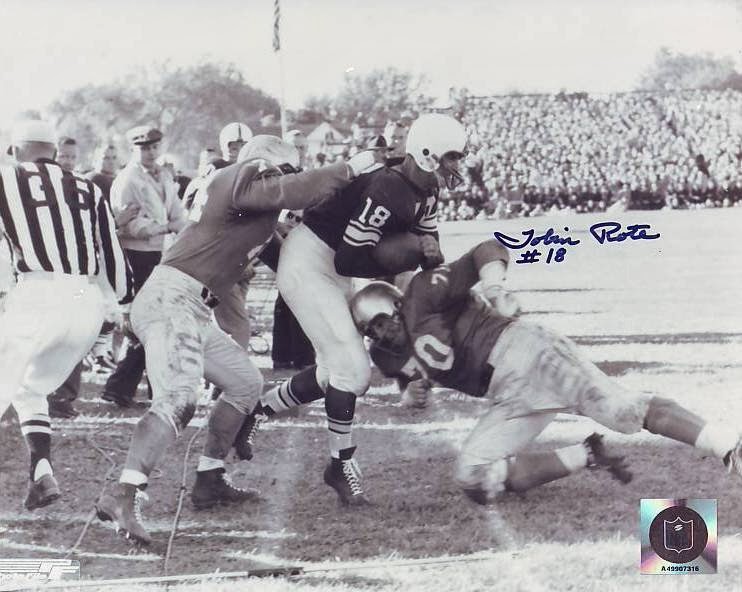
The green jerseys, apparently not worn during 1957, could have been left over from 1956. The photo below of Tobin Rote is from 1956, his last with the Packers and the Packers' last at City Stadium I.